Heli Deck Skidding

Lifting Solutions

Click here for Helideck Skidding Case Study

What Is Helideck Skidding?

A helideck is the designated landing and take-off area for helicopters on an offshore platform, vessel or other marine facility. It provides an essential access point for transporting personnel, equipment and supplies to and from offshore installations. But what happens when an offshore platform needs to use the space underneath or beside the helideck for another purpose?

In some situations, completely removing the helideck can be expensive, time-consuming and unnecessarily disruptive.

Helideck skidding provides another option.

Helideck skidding is the controlled horizontal movement of a helideck structure along specially prepared skid beams or tracks. Instead of lifting the entire helideck vertically, the structure is moved sideways or backwards to create the required working space.

Simply put:

Lift it less. Move it smarter.

A helideck can be a very large and heavy structure. Moving one requires detailed engineering, structural assessment, careful planning and specialized mechanical handling equipment. The process may involve extending existing skid beams, installing or preparing a suitable skidding system, checking load paths and then moving the helideck in a controlled direction.

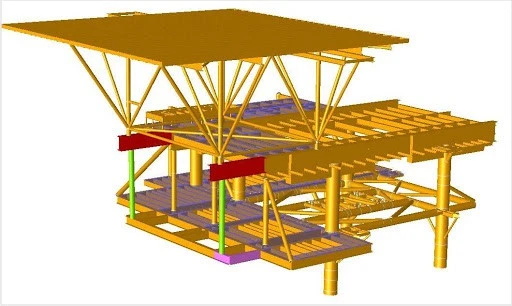
Thunder Crane helideck skidding system with yellow structural framework and multi-level platform design

Why Would a Helideck Need to Be Moved?

Offshore platforms often need to adapt as their operational requirements change.

For example, an operator may identify a new well location underneath or close to an existing helideck. A jack-up drilling rig may need access to that area, but the helideck is physically occupying the required working space.

One option could be to remove or dismantle the helideck.

However, this can introduce significant lifting, marine logistics and project costs. Helideck skidding can provide an alternative. By temporarily repositioning the helideck, the operator can create the required space while keeping the structure intact.

This can be particularly valuable when the helideck needs to be moved only a relatively short distance.

How Does Helideck Skidding Work?

The basic concept is easier to understand than the engineering behind it. Imagine a very heavy structure sitting on rails. Instead of picking the entire structure up with a crane, a controlled mechanical system moves it horizontally along the rails.

A simplified process looks like this:

ASSESS
↓
Inspect the platform and existing helideck structure.

ENGINEER
↓
Determine the required movement, load paths and structural requirements.

PREPARE
↓
Extend or prepare the skid beams and install the required skidding equipment.

POSITION
↓
Set up the mechanical system so the helideck can travel along its intended path.

SKID
↓
Move the helideck in a controlled and monitored manner.

SECURE
↓
Position and secure the helideck in its new location.

The objective is to move a very large structure safely and precisely without relying on a conventional heavy lift.

How Does Thunder Cranes Assist With Helideck Skidding?

Thunder Cranes provides engineered skidding and lifting solutions for complex offshore projects where conventional lifting methods may not be practical. For helideck skidding, the company can support the project from planning through execution.

This can include:

  • Site surveys
  • Engineering assessment
  • Load-path planning
  • Skid beam preparation and extension
  • Skidding system and winch rental
  • Rigging and mechanical handling
  • Controlled skidding operations
  • Offshore project management
  • Equipment and manpower support

Thunder Cranes’ complex rigging and lifting services specifically include skidding and specialized mechanical handling for offshore environments. The company describes these engineered solutions as ways of creating controlled movement when a load needs to travel from one point to another.

A Real Offshore Helideck Skidding Application

The basic concept is easier to understand than the engineering behind it. Imagine a very heavy structure sitting on rails. Instead of picking the entire structure up with a crane, a controlled mechanical system moves it horizontally along the rails.

Thunder Cranes has demonstrated this approach on an offshore platform in Malaysia.

The client needed to perform drilling activities at a new well location using a jack-up drilling rig. The planned drilling area was located beneath the existing helideck, creating an obstruction. Instead of removing the helideck, the platform’s existing skid beam arrangement was extended to allow the structure to be repositioned.

Thunder Cranes was brought in to provide the specialized helideck skidding capability. The helideck weighed approximately 120 tons and needed to be moved 7 meters backwards to create sufficient space for the planned drilling activities. The operation was planned to be completed within one day because delays could increase accommodation vessel and logistics costs.

Thunder Cranes completed the 7-metre movement in less than two hours.

The project demonstrates how controlled mechanical movement can provide an alternative to more complex and expensive offshore heavy-lifting methods.

Thunder crane Dubai HWO operations on yellow offshore oil platform with lifting equipment over ocean

Why Skid a Helideck Instead of Removing It?

Removing a large offshore structure can require significant equipment, marine support and planning.

Depending on the platform and project requirements, a conventional removal approach could involve:

  • Heavy lift equipment
  • Crane vessels or liftboats
  • Additional offshore personnel
  • Structural modifications
  • Marine logistics
  • Extended offshore project time

Skidding can offer a different approach. Rather than taking the helideck away, the structure is repositioned. This can reduce the scale of the lifting operation and allow the existing structure to remain available for future use.

Thunder Cranes’ published project describes helideck skidding as a more cost-effective and safer alternative to using a liftboat for that specific application.

Why Is Helideck Skidding Challenging?

Moving a massive structure a few metres may sound simple, but offshore conditions make the operation highly engineered.

The project team needs to understand:

Weight
How heavy is the helideck?

Movement
How far and in which direction does it need to travel?

Structure
Can the platform and skid beams support the required loads?

Load Path
How will the forces travel through the structure during movement?

Alignment
Can the helideck move smoothly without unwanted lateral movement?

Space
Is there sufficient clearance around the structure?

Timing
How quickly must the operation be completed?

These factors need to be assessed before the movement begins.

Thunder Cranes’ approach includes site surveys and detailed lift or movement planning to establish a controlled execution strategy.

A Specialist Solution for Complex Offshore Projects

The right solution depends on the structure, available skid beams, movement distance, platform configuration, load requirements and project objectives.

Thunder Cranes works with clients to understand the challenge, assess the available structure and develop an engineered solution for controlled offshore movement. From site survey and engineering to equipment supply and skidding operations, Thunder Cranes provides specialized support for complex offshore lifting and mechanical-handling projects.

Need to Move a Helideck or Heavy Offshore Structure?

Tell us what needs to move, how far it needs to go, and what is around it.