Wireline or E-Line

Lifting Solutions

Click here for Wireline Case Study

What Is Wireline or E-Line?

Wireline is a method used to perform work inside an existing oil or gas well without requiring a conventional drilling rig.

E-Line, short for Electric Line, is a type of wireline operation that uses an electrically conductive cable to lower specialist tools into a well. These tools can be used to collect information, measure conditions, inspect the well and perform specific well-intervention activities.

In simple terms, imagine a very long, strong electrical cable carrying specialist tools down into a well. The tools perform the required work underground, while the equipment at the surface controls the cable and monitors the operation.

A typical E-Line package can include a large cable reel, winch, control equipment and specialist downhole tools. Before the operation can begin, this equipment must be transported to the offshore platform, lifted into position and set up around the wellhead. For offshore operations, this can create a significant logistical and lifting challenge. The equipment can be heavy, the platform may have restricted deck space, and the existing platform crane may not have enough lifting capacity or reach. This is where Thunder Cranes provides specialist offshore lifting support.

How Does Thunder Cranes Assist with Wireline & E-Line?

Thunder Cranes provides modular and temporary crane solutions to help move, lift and position E-Line and wireline equipment on offshore platforms. The support can begin when the E-Line equipment arrives offshore on a supply vessel.

Heavy components such as cable reels and other equipment may need to be lifted from the vessel onto the platform. Once on deck, the equipment must be positioned correctly so the wireline team can carry out the well intervention. For projects involving multiple wells, E-Line equipment may also need to be repositioned or skidded between wellheads. Thunder Cranes provides the lifting capability required to support these movements.

The Process is simple:

Supply Vessel – E-Line equipment arrives offshore.

Thunder Crane – Heavy equipment is lifted onto the platform.

Platform Deck – Equipment is positioned where it is required.

Wellhead – The E-Line equipment is set up for the intervention.

Well – Specialist tools are lowered into the well using the electric line.

Thunder Cranes’ role is to provide the lifting support around the well-intervention operation, allowing the E-Line team to focus on the work inside the well.

What If the Existing Platform Crane Isn't Strong Enough?

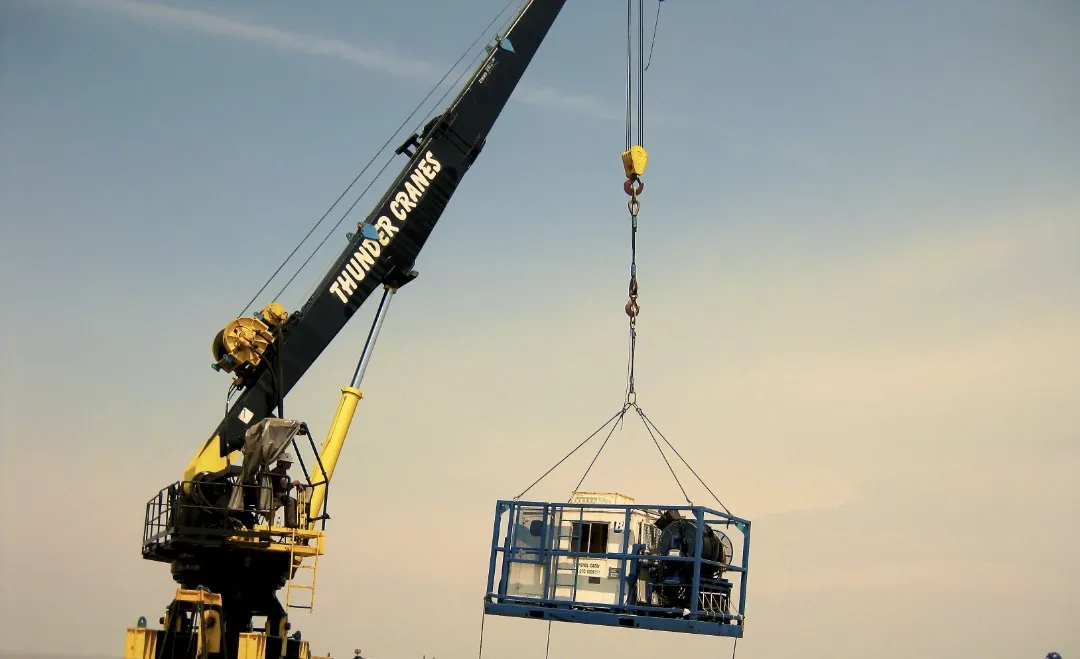
An offshore platform may already have a crane, but that crane may not be suitable for every project. For example, Thunder Cranes’ published E-Line project involved a platform where the existing crane could not lift the heaviest E-Line component, which weighed approximately 4.5 tonnes. Thunder Cranes supplied a TC15 Stiff Leg Crane to provide the additional lifting capability required.

The crane was transported to the remote offshore platform by supply boat, assembled offshore and secured to the existing structure.  This demonstrates an important principle:

Having a crane doesn’t always mean having the right crane.

The required lifting solution depends on the equipment weight, lifting radius, available deck space, platform structure and the specific requirements of the operation.

Supporting Equipment Movement Between Wellheads

For someone unfamiliar with oil and gas operations, the process can be simplified into five steps:

Offshore well-intervention campaigns can involve more than one well. Once E-Line equipment has been installed and an intervention is completed at one wellhead, the equipment may need to be moved to another location. This can be challenging when the platform has limited space or when equipment is too heavy to be moved manually.

Thunder Cranes can support the skidding and repositioning of E-Line equipment, helping move the package between wellhead locations as required. This means the crane’s role isn’t limited to one lift.

It can support the wider movement of equipment throughout the intervention campaign.

Why Use a Modular Offshore Crane?

A conventional crane vessel can provide significant lifting capacity, but it may not always be the most practical solution for a focused offshore well-intervention project. A modular crane can be transported in sections, assembled offshore and configured around the requirements of the platform.

This can provide a flexible alternative when:

  • The existing platform crane has insufficient capacity
  • The existing crane does not have enough reach
  • E-Line equipment is too heavy for the platform crane
  • Equipment needs to be lifted from a supply vessel
  • Equipment needs to be moved between wellheads
  • Platform deck space is restricted
  • A large crane vessel would be impractical or uneconomical

The objective is not simply to provide the biggest crane possible.

It is about providing the right lifting solution for the job.

Need Lifting Support for Your Wireline or E-Line Operation?

Tell us what you need to lift. We’ll help you work out how to lift it.